
Introduction
Bio-based materials, bioeconomy and circularity are rapidly gaining importance in a world of finite resources, but what exactly are bio-based polymers and why are they important? From a definitional point of view, “[b]io-based polymers are biodegradable polymers extracted/obtained from plant, animal, and microbial sources” (Zia et al., 2021). They can be produced using legacy or innovative processes. Legacy processes include biosynthesis by microbes, fermentation to bio-based monomers, and industrial acetylation, which is typically used for cellulose acetate production. Innovative processes reflect recent technological advances and include metabolic engineering, biocatalysis and thermo-chemical conversion.
Sustainability ambitions and the desire to conserve finite resources increase the relevance bio-based polymers like cellulose acetate. This is also reflected in more recent work done by the European Union, such as the Circular Economy Act, the Bioeconomy Strategy and several more. All together, these initiatives focus on the transition towards a bio-based circular economy and increased uptake of bio-based raw materials. The goal is to reduce the dependence on fossil resources like petroleum by defossilizing supply chains and end-products. Cellulose acetate, as a bio-based polymer, has the potential to support these sustainability ambitions due to some key features.
"The bioeconomy offers Europe a chance to strengthen its resilience, replace fossil-based materials and products, create jobs and lead the global shift to clean industries. With this new [Bioeconomy] Strategy, the EU will support activities that provide sustainable practical solutions using our biological resources in sectors such as agriculture, forestry, fisheries, aquaculture, biomass processing, biomanufacturing and biotechnologies."
Bio-based polymers are emerging as a key pillar of the transition toward more sustainable materials, offering renewable and often biodegradable alternatives to conventional fossil-based plastics. Derived from plant resources such as cellulose, starch, pectin, alginate, and chitosan, as well as from microbial fermentation processes, these materials combine environmental benefits with a broad range of functional properties. Unlike traditional polymers, which contribute significantly to waste accumulation, greenhouse gas emissions, and microplastic pollution, bio-based polymers can help reduce reliance on finite fossil resources while supporting circular economy models. Advances in biotechnology, material science, and processing technologies are accelerating their commercial adoption and expanding their performance capabilities across numerous industries.
The diversity of bio-based polymers enables applications ranging from packaging and agriculture to healthcare, cosmetics, and advanced engineering. Plant-based polymers are valued for their abundance, renewability, and versatility, while microbial polymers such as polyhydroxyalkanoates (PHAs), bacterial cellulose, pullulan, and xanthan gum offer highly tunable properties and scalable production routes. Many of these materials exhibit biocompatibility, making them particularly attractive for medical applications such as drug delivery systems, tissue engineering, wound care, and biodegradable implants. At the same time, ongoing innovations - including polymer modification, nanotechnology, and hybrid material design - are improving mechanical strength, barrier performance, and processing characteristics, helping bio-based polymers move closer to mainstream adoption as sustainable alternatives to conventional plastics.
If you would like to read the articles related to the topic that provide more detail and insight into the above, feel free to browse our publications.
Classification of bio-based polymers based on carbon content
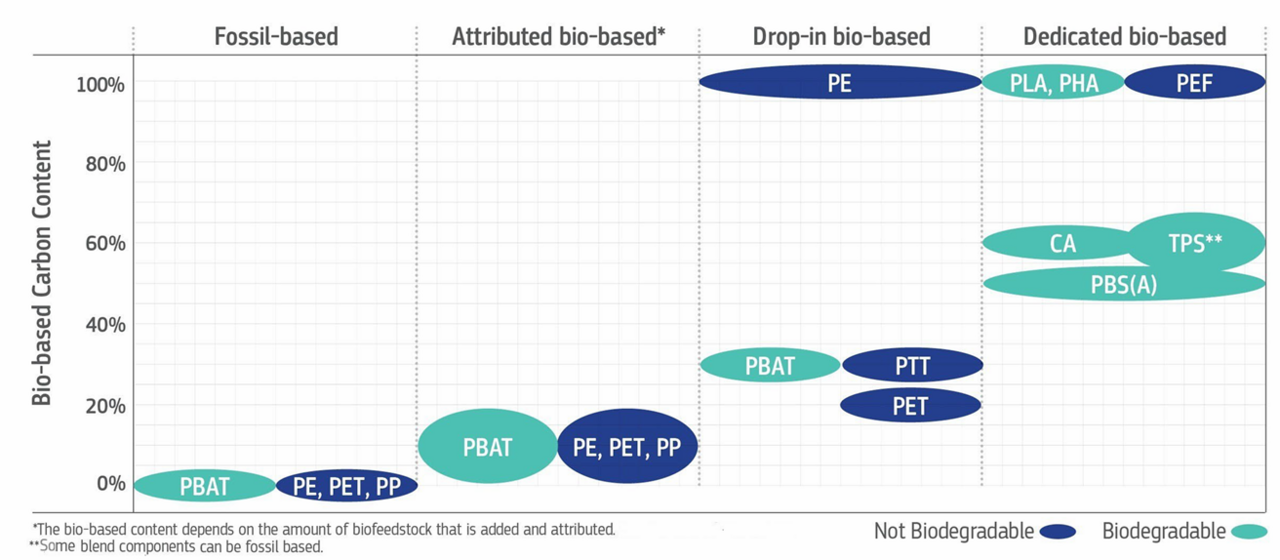
A policy brief published by the European Joint Research Centre (Molenved et al., 2026) classifies polymers based on their bio-based carbon content, suggesting the following four categories:
Fossil-based: Plastics produced using exclusively fossil feedstocks, whereby the most commonly used feedstock is naphtha.
Attributed bio-based: Bio-based plastics produced using biomass-derived intermediates. The bio-based inputs can be attributed to output volumes using the mass balance approach, a mass-based attribution methodology.
Drop-in bio-based: Use biomass-based polymer building blocks identical to those produced using fossil inputs. This allows for substituting fossil-based inputs through bio-based inputs, while product properties remain identical.
Dedicated bio-based: Types of bioplastic developed to produce plastic products from biomass. These materials are produced (i) by modifying natural polymers, (ii) through the production of bio-based building blocks, and (iii) directly by micro-organisms.
The graphic below illustrates their categorization of materials and the bio-based carbon content in percent for each of the materials.
Abbreviations
| CA - Cellulose acetate | PBAT - Polybutylene Adipate Terephthalate | PBS - Polybutylene Succinate |
| PE - Polyethylen | PEF - Polyethylene Furanoate | PET - Polyethylene Terephthalate |
| PHA - Polyhydroxyalkanoates | PLA - Poly Lactic Acid | PTT - Polytrimethylene Terephthalate |
| TPS - Thermoplastic Starch |